Origin of Pasta - Gianluca Re Fraschini "Per una Buona, Sana Cucina"
Menu principale:
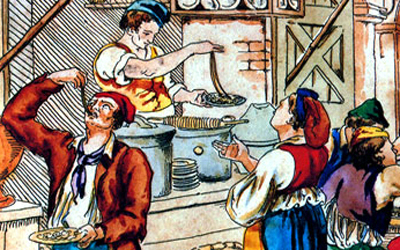
Do you know about the origin of pasta?
Whenever I look at a fountain of flour and water I can but think of what has been written and known about the origings of Pasta; some archaeologists had believed to recognize in some old Etruscan wall paintings primitive methods and tools used to prepare some sort of Lasagne and Tagliatelle.
Inexplicably though, during the following centuries no other findings witenessed to the evolution, diffusion, making and consumption of this popular nutriment.
During the Roman-
The legend according to which Marco Polo was the first to inport the use of Past is hardly probable because when he came back from China in 1295, Pasta had already been known in Italy. Evidence of this can be found in some lines of Jacopo da Todi as well as in some "inventories" of bourgeois mansions in Genoa written in the half of the XIII century describing some jars for the preservation of Pasta.
According to some historians, Pasta started to be well-
The Arab invasion of Sicily brought about new cooking usages in the isle. In the following centuries the art of Pasta-