Andrea Palladio - Gianluca Re Fraschini "Per una Buona, Sana Cucina"

Vai ai contenuti

Menu principale:

Do you know..


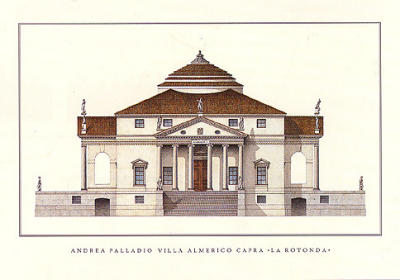
ANDREA  PALLADIO, architect (1508 -1580)

was really fond of a special recipe  "Livers of Paduan chickens with prunes" that he tasted while drinking must on an end-of-summer evening..At that time he wasn’t aware of how his innovative design would affect modern architecture.
After 400 years his style is still a reference point all over the world and the best way to completely appreciate the beauty of his villas is to visit that part of land stretching from Venice to Vicenza, sorrounded by the Brenta river.

THE CHICKENS FROM PADUA  
Origin, diffusion and economical characteristics
This is an ancient Italian breed of chickens whose origin is still under investigation. According to Darwin it came from Poland (probably it arrived in Italy during the IVXth century thanks to Giovanni Dondi Dell'Orologio, a nobleman from Padua, excellent doctor and astronomer who was delighted by the beauty of this poultry).
A well-defined origin is however unclear. Some think that it might result from a combination of both Polish and Dutch poultry, distinguished by the explosive topknot of feathers but with no beard.
Many quotes dating back to the XVIth century talk about a particularly productive and famous breed of chickens in the Paduan region. The Paduan high-tufted breed is well-described and illustrated in the Ornithologiae by Ulisse Aldovrandi (1600).
Nonetheless the decay of the Paduan breed started back in the XIX th century.
At the beginning of the XXth century the breed still counted some thousands units but in the 60’s these chickens disappeared almost definitively.
All the farmers being associated to the Presidium are members of the “Pro Avibus Nostris” syndicate at the “San Benedetto da Norcia” Professional Institute of Agriculture, Padua.
Apart from the ornamental fowl, this breed is particularly employed for profitable chicken farming, particularly to give an additional value to typical chicken breeding or to improve farming in protected areas. These chickens produce very big eggs (50 – 60 gr each) with white shells. Their meat has a white-rosy colour with a poor amount of fat, the flavour is very delicate.
The cocks reach their sexual maturity in six-seven months whereas the chickens in five-six months. In Italy this is an officially recognized breed. Their body is slender, elegant. These birds are lively and ornamental with a calm temper.
Chickens do not sit long on their eggs and are not prized for their laying qualitites. Cross-breeding is categorily avoided since these birds are farmed especially for the production of eggs.

PREPARATION
Prepare all ingredients; clean the onions, peel, clean, dry and cut them into thin slices; cut both bacon fat and bacon into cubicles. Use a casserole - better an oval tin-plated copper one; put both oil and lard inside it; heat slightly and add onions, bacon fat and bacon, meat and pork. Stow everything at mild flame for about an hour, evenly browning both meat and pork. You can possibly cover the casserole, but do not seal it completely. Remove the cover from time to time. In the end the onions should appear creamy and softly browned. Add gradually the wine, pouring it at small amounts and let it evaporate. Mix together the tomato paste and sauce so as to obtain an homogeneous compound and pour it on the meat and pork. Let it stove at an extremely mild, almost invisible flame for about 4 hours. The ragout should gently simmer - "pippare" as Neapolitans and Eduardo said. Stir from time to time since the very start and let the cover ajar so as the ragout can "breathe" and at the same time be adequately hydrated; remove the cover from time to time. Stir gently and remove the tomato brownish deposits forming all around inside the casserole and add them again to the ragout. Add salt only almost at the end of the cooking process and only if it is strictly necessary. Remove the meat and pork from the casserole and let them rest for a few minutes before slicing and serving as second course. Use the ragout to accompany a good dish of pasta: "paccheri" for instance are a wonderful tradition!

 
Torna ai contenuti | Torna al menu